I have only just started looking threw these files, but already I have found some awesome stuff.
I started at the end, and searched for all instances of "boards" and just read all the references.
There was a link to a site containing a good description of the bands history,
http://imusic.com/showcase/indie/boardsofcanada.html.
Using the wayback machine I looked at the oldest version of the page.
I havent read it before and it provides loads of details I havent read anywhere else.
To save you all the bother i'll post it here.
[this could probably be moved to the wiki or another page, sry in advance

]
Boards of Canada:
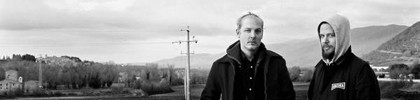
michael sandison (b.1971)
marcus eoin (b.1973)
1977-1980: both started learning piano and guitar in the late seventies. mike & marcus had lived in London & Calgary as children in the seventies.
1980: michael's first schoolband (c.1980) comprised live drums, bass and keyboards. sounded like video game tunes repeated to infinity.
1981-1982: michael and marcus were captivated by the earnest simplicity of documentary filmmaking on television, and the accompanying soundtracks.
1983: michael made his first super-8 movie with schoolfriends. the film included special lighting effects creted by damaging the film in various ways.
1984: michael's first visit to a recording studio (arranged by a music teacher) yields three or four multi-tracked synth tunes, which he later performs at school with the aid of a reel-to-reel accompaniment (no sequencers available to him). both michael and marcus were at this time recording found sounds from television and punching them into sequences of a very basic household tape-recorder. the duo began a crude form of multi-tracking by bouncing tracks back and forth between the tape recorder and an old hi-fi. Instruments used included pianos, voices & schoolbags!
1984: marcus began programming multi-tracked melodies on his BBC Microcomputer. he composed mathematically, once notably writing an entire tune as a mathematical palindrome.
1985: began making the first of many tapes of experimental tunes, mostly very melodic but instrumental.
1986: michael formed a new band, this time with a full line-up of drums, bass, guitars, vocals. once played a cover of "L.A." by The Fall, who spookily turned up eleven years later on a Skam compilation "0161", Skam being the first label to release a Boards of Canada EP.
1986: michael invited marcus to join the band, and marcus played bass, more synths joined . . .
1987: the full band (then a five-piece) performed at an all-night music marathon where a stage invasion resulted in members of the audience playing some of the keyboard parts. " . . . one person for every key on my synth. It was chaos. We just left the stage and watched . . .", michael says this was some of the best music the band has ever played.
1987: at another all-weekend music marathon, michael consumed a massive amount of Pro-Plus and performed a six-hour drum solo onstage from 1am to 7am.
1988: michael bought what he now describes as the band's "secret weapon" synth from a friend for £100 whilst travelling on a bus.
1988: the collective surrounding the bandbegan making unusual films (later under the name Music70), mostly on super-8 or video. the films were sometimes coherent stories, sometimes fractured messages. the tone of the imagery of the band's filmaking & photography at that time was nostalgic, minimal and electronic; portraits of electric pylons, coupled with music that might have been written by eletric pylons; a sinister story of a road journey into the patterns on a peacock's tail.
1989: two band members left and the remaining three of michael, marcus and chris decided to carry on by borrowing money to purchase more electronics.
1989: the trio began recording at a professional studio, whilst putting on occasional nights for friends where they played tapes of television themes with horrific reversed vocals mixed over the music.
1990: a series of collaborations with various friends took place, resulting in multi-layered guitar songs with a dark, orchestrated feel.
1991: marcus left university to concentrate on the construction of a powerful recording studio, which mixed old, cheap technology with new.
1992-1994: various musical and visual projects took place, whilst the band began regular "Redmoon" nights at a ruined monastery stable near their studio in Scotland. people would turn up to several large bonfires at these nights, to listen to old children's television themes being mixed over steady electronic pulses.
1995: in the summer of 1995 the band and their friends christened the studio in the Pentland Hills, "Hexagon Sun", and the collective have continued their work on recordings, films and gatherings from this location. (every year in the spring and summer, Hexagon Sun hosts various small rural music gatherings, which attract many local heads.)
1995: the band recorded their first vinyl EP by financing it themselves. the result is "Twoism", a limited edition collection of grainy, melancholy melodies over slow, dry electronic rhythms.
1996: Chris left the band. Autechre's Sean Booth contacted the remaining duo and michael and marcus recorded the Hi Scores EP for Skam records. the band played alongside Autechre, Panasonic and Cylob in London in July 1996.
1997: Skam Records and Munich's Musik Aus Strom teamed up to release a series of very limited compilation EPs under the name "MASK", the first of which included an exclusive track by Boards of Canada. The second MASK installment contained a track by the band's alter-ego, "Hell Interface."
1997: in the spring of 1997, Boards of Canada contributed the track "Turquoise Hexagon Sun" to the compilation album "Bento Box" on New York's Caipirihna label. The band also contributed two tracks to Skam Records' "Skampler" compilation, released in the US in conjunction with Silent Records.
1997: Boards of Canada gave a few performances around the UK, notably including a performance at the Phoenix Festival in July, 1997, building a reputation with their use of onstage video visuals which cut from super-8 movies to "blipvert"- style subliminal messaging. meanwhile they released a couple more dark tunes under the pseudonym "Hell Interface". BOC remixed "Surfaise" for Funkstorung's Michael Fakesch in the summer of 1997. Hell Interface contributed a track, "Soylent Night", to a limited edition 7" in collaboration with V/Vm in December 1997.
April 1998: after a remix for Mira Calix on Warp Records, and a limited edition 7" release of Aquarius on Skam Records, the duo completed an album for a joint release between Skam & Warp Records in April, 1998 titled "Music Has The Right To Children".
May 1998: the newly released BOC debut album received excellent reviews in several music publications in the UK.
June 1998: BOC contributed an exclusive track to Warp Records' commemorative 100th release 'WAP100' in June 1998, on a springtime feel, and completed a remix for Bubbah's Tum on iLL Records, for release in June 1998. BOC produced an exclusive session for the John Peel show in June 1998.
The Future: BOC will be releasing their second album on Warp at the beginning of 1999. The band's film production collective, Music70, is writing for various small projects to be completed later in the year. The band promise to deliver a large film project in 2-3 years' time.
[/quote]
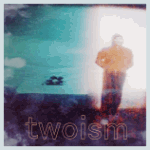
 . They did one of the first live webcasts of a gig they played.