Hey guys and gals, I've been mapping and analyzing the structural components of Jacquard Causeway, and I think I found an interesting pattern.
If you count out the synth part before the beat drops (the 'intro'), there are 39 eighth note counts. The 39 counts are broken into three bars:
Bar 1: 1 e + 2 e + 3 e + 4 + 5 e + // fourteen eighth notes
Bar 2: 1 e + 2 e + 3 e + 4 + 5 e + // fourteen eighth notes
Bar 3: 1 e + 2 e + 3 e + 4 + // eleven eighth notes
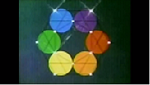
So, imagine that each eighth note represents a hexagon. The intro structure can then be translated into a hexagonal isormorphism:

Once the beat comes in, the time signature is 3/4. There are 210 bars of 3/4 in the body of the song. It gets a bit complicated, but basically the intro and outro combine to make 24 more bars of 3/4.
That brings the total number of bars of 3/4 in Jacquard Causeway to 234. And, 234 / 6 = 39
In other words, there are 39 groups of 6 bars of 3/4.

What do people think of this? Here are my conclusions thus far:
1. It seems there's a 'thumbprint' of the song within the song. Or following the analogy of a Jacquard loom, the intro 'thumbprint' could be viewed as the 'card sequence' of a Jacquard loom, while the song (paradoxically including the intro) is the finished textile.
2. 39 is 36 plus 3, so it's six 6's and half a 6. This could relate to the "I overflow man" text on the Japanese CDs.
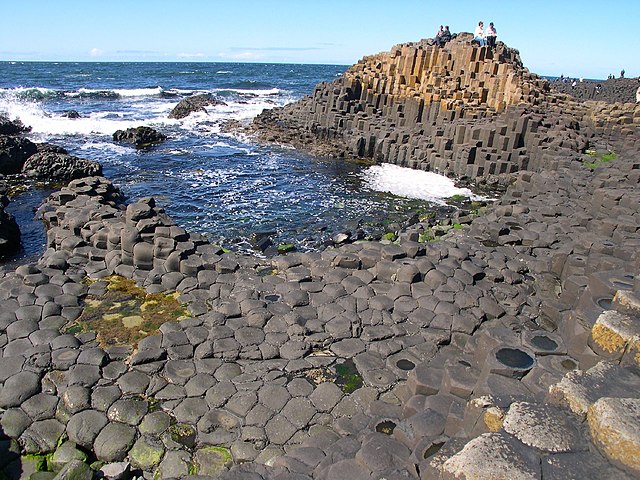
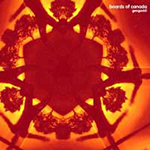
3. The image is beautiful, symmetrical on 3 axes, and manifests all the numbers 1-9 in some way. It is also the most "geometrically regular" to fill in the space. Who knows if the particular image I designed is exactly what BoC had in mind, but the pattern on a more abstract level seems too clear to be a mistake.
4. This is more fun trivia, but the piano card was a part of the Jacquard loom that allowed the "engineer" to "press down or not" on 8 punches per press, as you punched holes into a card. So, things were grouped in 8s, like bytes. the analogy of choosing specific groups of 8 (bytes) would extend to the computer-using musician. And of course one of the clues from that old youtube video of "Julie and Candy" was "computing".
-=-=-=
I've been analyzing other songs in Tomorrow's Harvest in a similar manner, but this one really seemed to be speaking to me, so I decided to post it. If people are interested in hearing more of my thoughts on how the song's structures and properties relate to the semantic content brought up by song titles, album imagery, etc, let me know; I'd be happy to contribute.








 ∴
∴