I've been thinking a lot about the discussion around Inferno and, honestly, I felt the need to get all of my thoughts in one place and out of my head. So I wrote a piece that pulls together and refines different posts I've made over the past two months since I joined. I was going to include more but quickly realized some of that stuff would be better served in a different piece. Special thanks to Joshu_atx for sharing the Giraud's Mirror connection--I quoted you in one spot here. That idea really ignited my imagination.
Please note that I hold all of my speculation here with a very open hand and am very probably wrong on many counts, feel free to please poke at them all you want (or walk away from the wall of text). I'm just a rando on the internet and I have no connection to or insider knowledge of Boards of Canada. I just get carried away sometimes--hopefully once I post this I'll be able to give my rekindled BOC obsession a bit of a rest for a while!
PS, no AI was used in writing this. I just use a lot of emdashes, I promise. Old habits die hard.
------
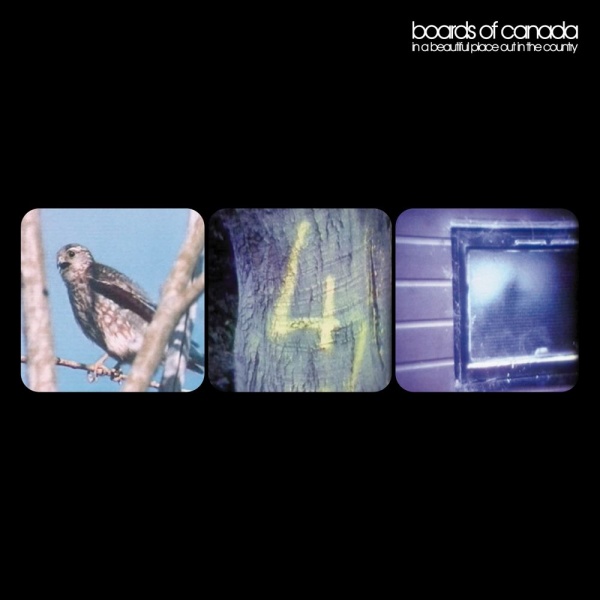
Inferno. Where to begin? I have an old copy of In A Beautiful Place Out In The Country framed and hanging on my wall. The morning after my first listen to the new album, I found myself entranced with the words "boards of canada" as they appear on that now 26-year-old EP. Those familiar words were RADIATING a new energy to me. The roundness of the letters is now intermixed with memories of the fever dream that is Inferno. It's as though those shadows always stretched dancing behind them, but only now have come into view. Like everything they've done was all pointing somewhere off the map, and Inferno was that somewhere.
I also felt a sense of peace. Like if they ended it here, I'd be perfectly content. In the 13 years between Tomorrow's Harvest and Inferno I'd almost accepted that a new release might not come. Then it did.
It started with a VHS tape. The part of that cryptic video that interested me the most was the opening disclaimer prohibiting the diffusion of its contents. There's an irony in how this was part of a campaign intended to get the word out, yet it mirrors the story of betrayal in BOC's Old Tunes era tapes. They only shared those 4 tapes with a few trusted people, but they were leaked anyway. Fast-forward to 2026. Fans receive a VHS tape that expressly asks them not to distribute its contents--and what happens? It is digitized and diffused online, picked apart frame by frame, and is now free for all to view. Tape 5 indeed!
Not only does it feel self-referential, but it also reflects the surrender in release. Works of art that are released are truly let go of by the creator. In the Inferno VHS we saw in real time how they are consumed, distributed at scale, and digested by not just the fanbase but today's consumer technology itself in the exploitative shadow of genAI.
BOC didn't need to do anything more than send out this tape: the machine did the rest! This is a gastronomic--perhaps infernal--process. When something is put online it is literally consumed either by the abyss or by frenzied masses (eg, BOC fans). Inferno is both another log on the fire and a mirror reflecting back what could be considered the all-consuming hellfire of the internet and its influence on people and civilization.
After the VHS tape went out, the stakes were high. 13 years is a long time to go without releasing a scrap of new music, so when Tape 05 dropped, the Brothers Boards weren't messing around. Fortunately for us, its beauty was met with a virtual standing ovation from fans across the Youtube comments section, the Twoism fan forum, and beyond.
I think its use of harp says a lot. In the context of faded media music from the past, its crisp live harp is real: it's the present. Organic. Ringing out with lucidity while enrobed in the fingerprints of time. The eerie reminiscence of this piece to so many threads of BOC's past work all woven masterfully into three minutes and twenty-two seconds evokes absolution. Release--as a new release, a return, and possibly the completion of Boards of Canada. If Inferno is the final Boards of Canada release, then in some sense the band is dead and their body of work enters an afterlife: so you hear angelic harp. The vocals fading in at the end of Tape 05, a community of listeners that live on after the music is done. Followers. It is really fitting in this context that the lucid harp comes in to play what may be the most quintessentially Boards of Canada melody ever written. I feel it captures that moment when you're one with your instrument and a melody just comes out of your fingers like it was channeled through you by the univese, and you're just a medium. Like this is what BOC came to do. Culmination. Not just the past inside the present, but the whole of time in this one moment.
But is Inferno really it? Will there be another album? Or at least another EP? Dare I say, the fabled BOCset?
Before I weigh in on my thoughts around that question, let's take a look at another mystery, one that sits apart from Inferno. One that falls enticingly from its pages--small, flimsy, diaphanous, hexagonal, unassuming, yet contains apparent multitudes:
Giraud's Mirror.
What is the significance of 177? Why the 1983 recording date? The McDonalds sample enjoining us to gift one's brother with a smile? The Blue Rose? I won't dig into all the questions it raises here, but I'd like to focus in on a few trailheads.
Let's start with the artifact itself. Not the hexiflexidisc, but the eponymous mirror. Twosim user Joshu_atx discovered that this unique mirror was created by author and artist Marcel Giraud. To quote Joshu_atx, the mirror has "6 sides (hexagon, akin to the flex-disc) and 5 loops (5 BoC albums) with a beginning and ending place for the candles but connected overall. This bonus disc is like a bookmark / reset and unifies the whole discography together. It’s 'everything' self-contained in one journey. The candles illuminate the mirror. The mirror is what the listener gets from their music reflected back on them." I'd also like to add that the frame is vaguely turquoise in color.
Giraud's Mirror, among other things, suggests the possibility of a model for the arc of Boards of Canada's mainline albums. Several quotes from the brothers could imply this is something they had in mind since their early days. Based on one of their earliest interviews from 1997, it appears it wouldn't be the first time they had a grand project in mind involving a framework of 5 entries:
Mike Sandison: "We have a small company called Music70 and it also produces Super 8 and video films, many of which are quite experimental. I myself am also doing some of these film works and we will soon be shooting our first Super 8 film in feature film length, complete with our own music."
What is the theme of this film?
MS: "It will probably be a road movie, but also in a rather broad concept. It is supposed to be a road movie in five parts and that is all we know at the moment."
Digging through some of their allusions to mirrors in other interviews extends this line of thinking:
"Like the intro on 'Julie and Candy' for example, we just played the melody on a couple of whistles and then we bounced it back and forward between the internal mics of two tape-decks until the sound started disappearing into hell. Like when you look at an image reflected within two mirrors forever, in the distance it gets darker and greener and murkier." -Mike
"Fish and Humans help to form the hexagonal mirror image of the world, as does the presence of birds and all wildlife." -Mike
"We create music that seems to have its own universe and time. That place is another reality. It always exists just around the corner, or beyond the mirror."
"[It's] probably 'a soundtrack to a place like the other side of the mirror'. Listening to it, you can dive into an alternate version of the world you know, where history branches off and everything heads in a strange direction." -Mike
"When I was a kid, about five or six years old, a relative of mine had one of those tacky ceramic owls on their mantelpiece, and it had multifaceted diamante eyes. I as totally obsessed with those sparkly glass eyes, for ages. I felt like looking into them was like looking sideways though everything, right through time. That's what we're trying to do with our music." -Mike
As fans of David Lynch's Twin Peaks may recall, the owls aren't what they seem. This brings us to the blue rose. The apparent decision to connect the dots between Turquoise Hexagon Sun and blue rose in Giraud's Mirror has some rich thematic implications. That cultural link in the artifact of this hexiflexidisc is a succinct symbol that summarizes a lot of the thematic and stylistic direction of Boards of Canada.
Unpacking what I mean a bit here, it helps to know Twin Peaks and some of David Lynch's artistic vision. In short, the blue rose represents phenomena that are perpendicular to reality as we usually perceive it, that transcend time and space in some way, that are supernatural. Lynch in more than one place has said that he thinks electricity and its ubiquity and power in our modern lives is a fascinating and underexplored topic. Electronic or electronically-mediated recordings (eg, music, photographs, websites) offer a means of transcending time. Without going into any spoilers, this is a major aspect of virtually all of Lynch's works, alongside the notion that we live in, essentially, a sort of dream. The illusory electrical world of perception.
BOC explores overlapping territory in the fallibility of memory and perception as well as the insidious influence that organizations can have on followers and world. Inextricably tied in with this, again, is electricity. Not just the electrical activity of the brain, but also technology as a mediator of power and control.
Related to this is the negative edge of nostalgia--not necessarily trauma, but the momentum of habit that we are often blind to while ending up in the same difficult situations time and again. Behavioral loops that get stuck on repeat in our psyches even as we age and conditions change, that continue to manifest in different guises that we mistakenly perceive as coming from outside of ourselves. In this way, our past, present, and future selves are contained in this one moment, with parts of ourselves frozen in the past.
Feedback loops are an extreme manifestation of this, the closed loop producing monstrous things with exaggerated features in our lives, dreams, and societies, frightening us until we can cultivate enough equanimity to face them head-on. The exaggerated, maybe even cartoonish, character of our demons when left unchecked kind of fits with the bit of camp horror in the design for Inferno.
Moreover, the relationship between electronic materials and folks who consume/use them involves power dynamics. The internet as it exists today, threatening presence of social media, surveillance capitalism, genAI, and all, is an extreme example of this--truly a sort of inferno in its own right. It exploits and amplifies our human faults to a point of self-destructive feedback. Simultaneously, it offers a hypnotizing facsimile of experience in the form of a never-ending kaleidoscope of recorded past events while the powers that be exploit and destroy more and more of the world and the human spirit.
Inferno isn't strictly a dark album. It's also about the process of turning to face your demons--individually and as a society--in order to transcend and move beyond them. To thaw the frozen parts inside. To befriend those exiled aspects of our psyche so we can rescue ourselves from the havoc they wreak when left unchecked.
Inferno is an invitation to shadow work, and Giraud's Mirror points to an artifact that seems to reach toward--but never quite succeeds in--transcending time.
Perhaps Giraud's Mirror encapsulates even more than the 5 albums of their mainline discography. Its supposed 1983 recording date is another piece of the puzzle--and this is where things start to appear grander. Before Boards of Canada, it's known that the brothers were dabbling in recording music at least as early as 1983. If Giraud's Mirror contains material that one or both brothers recorded in 1983, and Inferno finished production in 2025, that would, technically speaking, make Inferno an album 42 years in the making. What is Inferno about?
In the words of Douglas Adams: "life, the universe, and everything!"
So let's bring everything in. Let's go all the way back to the beginning:
If the structure of their mainline discography is around Giraud's Mirror, maybe the 5 pre-Twoism albums were like an early iteration or blueprint of this idea. Two mirrors:
Giraud's Mirror 1:
Catalog 3
Acid Memories
Closes Vol. 1
Play By Numbers
Hooper Bay
Middle Releases:
Twoism
Hi Scores
Giraud's Mirror 2:
Music Has The Right To Children
Geogaddi
The Campfire Headphase
Tomorrow's Harvest
Inferno
Between mirror 1 and 2 we have leaked materials--the old tunes tapes et al--that amount to compilations and demos. And, of course, Twoism and Hi Scores are the public middle releases between these two mirrors, with the later EPs offering a place to explore A-side outtakes.
I find it interesting that these two "middle" EPs both imply a mirroring, splitting, or dualism. In Twoism's case, note that in various spiritual traditions "sin" or "evil" is seen as coming from forgetting that we are all one--two-ism. As for Hi Scores, the "HI" has been speculated to stand for Hell Interface, Boards of Canada's mysterious and more sinister-sounding side project.
I believe Inferno's opener, Introit, offers potential support for this hypothesis: its looping melody not only employs a 5 beats per measure rhythm, but it's also palindromic. Maybe their mostly unheard first 5 albums and their 5 publicly-released mainline albums circle around Twoism and Hi Scores in the same way that the tracks of Tomorrow's Harvest do around Collapse, with 5 pairs of somehow related albums mirrored across over 40 years of work.
Looking at just the 5 mainline albums, there's a beauty to The Campfire Headphase sitting in the middle. It was intended to evoke the sort of sanctuary of sitting around a campfire. If you compare that symmetry to the symmetry of Collapse being the middle track on Tomorrow's Harvest, the same image of a radial pattern around a fire exists. The yin and yang relationship of one being a welcoming bonfire and the other, presumably, an atomic blast, reinforces the themes of precarious spiritual bliss and religious devotion teetering on wrath, corruption, and downfall. Notably, all five albums imply such a pattern in various ways: Music Has The Right To Children's TV glow, Geogaddi's burning Waco compound, the campfire, the atomic blast, and Inferno's nine rings of hell.
What if all of their releases follow this same grand pattern?
At this stage, I'll just leave you with three "very important thoughts."
One: Maybe "the greatest gift is the smile you give to your brother" sample in Giraud's Mirror isn't just a sweet recongition of BOC's musical journey together, but also a victory lap after completing a second conceptual Giraud's Mirror of releases. Two brothers, two mirrors.
Two: based on all this hypothesizing, my hunch is that we're not going to get another Boards of Canada album. However, I do believe we'll get fifth EP (assuming Aquarius and Peel Sessions don't count as EPs, but rather as a single and a live album respectively), and we may yet see a compiliation of unreleased materials.
Three: a quote from Marcus Eoin in the 2000 interview "Boards of The Underground," published right after the release of In A Beautiful Place Out In The Country: "One time we were out in the woods on a really wet day. My friend bet me I couldn't start a fire using only one match. But I managed to get this meagre little flame going in this damp little patch of ground. Then when we were about a mile down the road, we looked back and it was like, 'whoosh!' - the whole wood was on fire!"
Inferno!
Giraud's Mirror, BOC's Discography, and Other Thoughts
Moderators: Aesthetics, Drones, Hexagon Sun
-
Redd Panderson

- Eagle Minded
- Posts: 295
- Joined: Fri Apr 10, 2026 12:36 pm
Giraud's Mirror, BOC's Discography, and Other Thoughts
Verde Hexagon Hashbrown
-
WATER_CAN-_-
- Sherbet Head
- Posts: 772
- Joined: Mon May 02, 2011 1:33 am
Re: Giraud's Mirror, BOC's Discography, and Other Thoughts
One time we were out in the woods on a really wet day,
remembers Boards of Canada's Marcus Eoin.
My friend bet me I couldn't start a fire using only one match. But I managed to get this meagre little flame going in this damp little patch of ground. Then when we were about a mile down the road, we looked back and it was like, 'whoosh!' - the whole wood was on fire!
Everybody's favourite commune-dwelling creators of pastoral electronica, arsonists? Whatever next? Adverts for Shell oil?
I love the countryside,
Marcus protests, adding,
I hate the idea that animals or trees or anything might get hurt. I had dreams about it for months afterwards.



My heart is full of light and love and sugar and caffeine
I live inside an antiquated obsolete machine ♪
-
Redd Panderson
- Eagle Minded
- Posts: 295
- Joined: Fri Apr 10, 2026 12:36 pm
Re: Giraud's Mirror, BOC's Discography, and Other Thoughts
I should've put this in my original post, but I figured it'd be easy enough to find. All the same, here's Giraud's Mirror:

And some details:
And some details:
This exquisite mirror, crafted by Giraud in Vallauris, France, circa 1960, is a distinguished example of the country’s celebrated ceramic tradition. Vallauris, long renowned for its rich ceramic heritage, emerged as a thriving center for artisans in the mid 20th century, attracting influential figures such as Picasso, who collaborated with local potters, and Roger Capron, who revitalized the town’s ceramic industry following World War II.
The piece features a glazed ceramic frame thoughtfully integrated with candle holders, blending practical function with refined decorative appeal. Its design reflects the organic shapes, textured surfaces, and earthy glazes that define mid century French ceramics. Resting gracefully on a forged iron holder, the mirror harmonizes traditional craftsmanship with modern design sensibilities. Beyond its utility, it stands as a timeless testament to Vallauris’s enduring influence and the artistic excellence of French ceramics, making it a truly remarkable collectible.
Verde Hexagon Hashbrown
-
steeldancer-x
- Sherbet Head
- Posts: 812
- Joined: Mon Sep 19, 2022 6:52 am
- Location: USA
Re: Giraud's Mirror, BOC's Discography, and Other Thoughts
Putting this here just bc I don’t know where else to put it for right now: Mainly and namely personal reflections if any1curr
For a long while I funneled many of my modern anxieties into Tomorrow’s Harvest. Despite the overwhelming fear I gave myself, I also deeply cherished it for being the first album I was old enough to “live” through. Teaching me wisdom of a lot of different facets of things I’ve lived and seen through as I’ve matured. Tomorrow’s Harvest is a hilariously optimistic album actually, such an illusion.
The crazy thing now is that everything I conjured in Tomorrow has been summoned in Inferno. First, it’s not as bad as I imagined…. My anxieties are awfully primitive. But some of the realities are worse than I feared. And yet I am not nearly as afraid nor devastated than when I was. I have learned what true “humiliation” is.
I am excited to see what Tomorrow’s Harvest becomes for me in the forseeable future. This past seasoned listen was probably the most positively-sounding I’ve heard it yet in my personal journey.
For a long while I funneled many of my modern anxieties into Tomorrow’s Harvest. Despite the overwhelming fear I gave myself, I also deeply cherished it for being the first album I was old enough to “live” through. Teaching me wisdom of a lot of different facets of things I’ve lived and seen through as I’ve matured. Tomorrow’s Harvest is a hilariously optimistic album actually, such an illusion.
The crazy thing now is that everything I conjured in Tomorrow has been summoned in Inferno. First, it’s not as bad as I imagined…. My anxieties are awfully primitive. But some of the realities are worse than I feared. And yet I am not nearly as afraid nor devastated than when I was. I have learned what true “humiliation” is.
I am excited to see what Tomorrow’s Harvest becomes for me in the forseeable future. This past seasoned listen was probably the most positively-sounding I’ve heard it yet in my personal journey.
-
steeldancer-x
- Sherbet Head
- Posts: 812
- Joined: Mon Sep 19, 2022 6:52 am
- Location: USA
Re: Giraud's Mirror, BOC's Discography, and Other Thoughts
Forgot to add bc I am currently waging away:
I think subconsciously I pumped a lot of these types of feelings into TH is only because there are some deep griefs within the folds of that album, and it is deeply personal. I have a hard tome distinguishing if that is me, or reality. Maybe both haha
I think subconsciously I pumped a lot of these types of feelings into TH is only because there are some deep griefs within the folds of that album, and it is deeply personal. I have a hard tome distinguishing if that is me, or reality. Maybe both haha
-
Redd Panderson
- Eagle Minded
- Posts: 295
- Joined: Fri Apr 10, 2026 12:36 pm
Re: Giraud's Mirror, BOC's Discography, and Other Thoughts
I want to expand on some of the implications of the radial motif in Boards of Canada's work that I talked about in my original post, so I'm bringing together some ideas I posted in other threads and a diagram. I'm not saying BOC necessarily intended this (I have no idea), only that it's an interesting way to read some of the themes they're working with.
I believe that Boards of Canada's symmetrical 5-album structure could be seen as a model that compares the operation of memory across time to the radial shape of radio waves perhaps. It'd be a very poetic engagement with electronic music as a medium when you consider recorded electronic signals and their propagation and decay.
Here's a lil a diagram (forgive my handwriting) to help me explain what I mean by a radial model representing memory and behavior across time:

An individual gradually proceeds through each tier of the radial structure linearly through time, while each step in the model is also a loop, meaning that, for example, tier one on the left side of the crisis point (earlier in time) involves behavioral patterns that are similarly congruent to the tier one loop on the right side of the crisis point (later in time after mostly disengaging from a habit). As a result, the behaviors produce similar sorts of resulting situations for the person engaging in them. This means, among other things, that there's a sort of predictability associated with habit in that it contains the past (its origins) and the future (likely outcomes) in the present. As the "platonia" idea referenced at the end of Inferno suggests, time may be an illusion and the past, present, and future may really be one now. Habit in this model could be seen like a "reverse echo" from a crisis event that already exists in the future but hasn't happened yet.
Of course, in real life there isn't just one trauma event and resulting habit, and the progress of personal development definitely isn't linear. Really, there's lots of different overlapping significant events, behaviors, and histories--positive and negative, some traumatic and some not--all operating at the same time. The structure of the model still works. In relation to this, BOC's 5 mainline albums also seem to reflect that journey of life:
-Music Has The Right To Children: childhood, Sesame Street, wonder and whimsy with sinister undercurrents and systems beyond your reckoning but that mostly go over your head while leaving a funny feeling.
-Geogaddi: entering and living the teenage years, becoming aware of the light and the dark side of the adult world, beginning to feel angst and seeking after identity.
-The Campfire Headphase: young adulthood. Finding yourself. A new level of freedom after living with parents and before becoming a parent / taking on adult responsibilities yourself, including going on adventures / road trips, culminating in a moment of awakening around a campfire.
-Tomorrow's Harvest: adulthood to midlife crisis, possibly becoming a parent, reaching a personal collapse where old ways of living no longer work and even cause problems and gradually need to be let go // some of the same sort of dynamics causing problems at the societal level. More society-level than Inferno, involving the process of finding your place in relation to the world. The personal sacrifices that come with age, and yet also the beginning of "knowing the score" or the gradual refinement of wisdom.
-Inferno: entering old age, arriving at a personal understanding of your relationship to life and the universe. Joy of mastery. More personal and cosmic than Tomorrow's Harvest. Excorcising old demons at last, facing mortality/death and accepting loss, reflecting on your legacy and what you will leave the world once your time comes.
There seems to be some intentionality to The Campfire Headphase being the middle of their 5 mainline albums. Before The Campfire Headphase, there's the beauty and innocence and wonder and fear of childhood. Those older albums have a lower fidelity and, to some degree, a relative simplicity, like a faded photograph's clarity fading over time. After the pivot point of The Campfire Headphase, there's a more mature, cinematic clarity that explores light and dark and coming to terms with inner demons, societal demons, what you've wrought, and whatnot. The Campfire Headphase is that brief respite of freedom in young adulthood before the weight of responsibilities and the problems of old habits come crashing down on you.
I recently revisited Campfire Headphase, and Dayvan Cowboy struck me differently this time. The difference between the first half and second half feels transcendent! It's quite the transition with the drums fading in at right around the halfway point, and it had me wondering: if Dayvan Cowboy is on their middle album, where does it fall numerically across the tracks of all their mainline albums?
Sure enough, in the 90 tracks across their five mainline albums (excluding bonus tracks), Dayvan Cowboy is track 45. Pretty much exactly in the middle, with A Moment Of Clarity after and leading to the slower, moodier second half of TCH. This same tonal shift exists at the discography level, too, leading to that overall darker and more cinematic tone of Tomorrow's Harvest and Inferno.
Dayvan Cowboy is at the center of their five albums, it's the fifth track of TCH, and it's exactly 5 minutes long. Just look at the music video of folks falling to Earth from the upper atmosphere--it evokes groundedness and gravity's radial pattern of celestial objects in orbit!
I like to read the radial shape of the 7 tessellated hexagons used in the campaign for Inferno as an expression of these connections. Again, I'm not saying it was necessarily intentional, but I enjoy and wanted to share the connection!

I believe that Boards of Canada's symmetrical 5-album structure could be seen as a model that compares the operation of memory across time to the radial shape of radio waves perhaps. It'd be a very poetic engagement with electronic music as a medium when you consider recorded electronic signals and their propagation and decay.
Here's a lil a diagram (forgive my handwriting) to help me explain what I mean by a radial model representing memory and behavior across time:
An individual gradually proceeds through each tier of the radial structure linearly through time, while each step in the model is also a loop, meaning that, for example, tier one on the left side of the crisis point (earlier in time) involves behavioral patterns that are similarly congruent to the tier one loop on the right side of the crisis point (later in time after mostly disengaging from a habit). As a result, the behaviors produce similar sorts of resulting situations for the person engaging in them. This means, among other things, that there's a sort of predictability associated with habit in that it contains the past (its origins) and the future (likely outcomes) in the present. As the "platonia" idea referenced at the end of Inferno suggests, time may be an illusion and the past, present, and future may really be one now. Habit in this model could be seen like a "reverse echo" from a crisis event that already exists in the future but hasn't happened yet.
Of course, in real life there isn't just one trauma event and resulting habit, and the progress of personal development definitely isn't linear. Really, there's lots of different overlapping significant events, behaviors, and histories--positive and negative, some traumatic and some not--all operating at the same time. The structure of the model still works. In relation to this, BOC's 5 mainline albums also seem to reflect that journey of life:
-Music Has The Right To Children: childhood, Sesame Street, wonder and whimsy with sinister undercurrents and systems beyond your reckoning but that mostly go over your head while leaving a funny feeling.
-Geogaddi: entering and living the teenage years, becoming aware of the light and the dark side of the adult world, beginning to feel angst and seeking after identity.
-The Campfire Headphase: young adulthood. Finding yourself. A new level of freedom after living with parents and before becoming a parent / taking on adult responsibilities yourself, including going on adventures / road trips, culminating in a moment of awakening around a campfire.
-Tomorrow's Harvest: adulthood to midlife crisis, possibly becoming a parent, reaching a personal collapse where old ways of living no longer work and even cause problems and gradually need to be let go // some of the same sort of dynamics causing problems at the societal level. More society-level than Inferno, involving the process of finding your place in relation to the world. The personal sacrifices that come with age, and yet also the beginning of "knowing the score" or the gradual refinement of wisdom.
-Inferno: entering old age, arriving at a personal understanding of your relationship to life and the universe. Joy of mastery. More personal and cosmic than Tomorrow's Harvest. Excorcising old demons at last, facing mortality/death and accepting loss, reflecting on your legacy and what you will leave the world once your time comes.
There seems to be some intentionality to The Campfire Headphase being the middle of their 5 mainline albums. Before The Campfire Headphase, there's the beauty and innocence and wonder and fear of childhood. Those older albums have a lower fidelity and, to some degree, a relative simplicity, like a faded photograph's clarity fading over time. After the pivot point of The Campfire Headphase, there's a more mature, cinematic clarity that explores light and dark and coming to terms with inner demons, societal demons, what you've wrought, and whatnot. The Campfire Headphase is that brief respite of freedom in young adulthood before the weight of responsibilities and the problems of old habits come crashing down on you.
I recently revisited Campfire Headphase, and Dayvan Cowboy struck me differently this time. The difference between the first half and second half feels transcendent! It's quite the transition with the drums fading in at right around the halfway point, and it had me wondering: if Dayvan Cowboy is on their middle album, where does it fall numerically across the tracks of all their mainline albums?
Sure enough, in the 90 tracks across their five mainline albums (excluding bonus tracks), Dayvan Cowboy is track 45. Pretty much exactly in the middle, with A Moment Of Clarity after and leading to the slower, moodier second half of TCH. This same tonal shift exists at the discography level, too, leading to that overall darker and more cinematic tone of Tomorrow's Harvest and Inferno.
Dayvan Cowboy is at the center of their five albums, it's the fifth track of TCH, and it's exactly 5 minutes long. Just look at the music video of folks falling to Earth from the upper atmosphere--it evokes groundedness and gravity's radial pattern of celestial objects in orbit!
I like to read the radial shape of the 7 tessellated hexagons used in the campaign for Inferno as an expression of these connections. Again, I'm not saying it was necessarily intentional, but I enjoy and wanted to share the connection!
Verde Hexagon Hashbrown
-
Redd Panderson
- Eagle Minded
- Posts: 295
- Joined: Fri Apr 10, 2026 12:36 pm
Re: Giraud's Mirror, BOC's Discography, and Other Thoughts
Two recent things gave me a place to land this thread. Somewhere in these rambling posts is a more coherent article, but for now it's just going to exist as it does here.
The first thing was the conversation on pages 31 and 32 of the 01. / 02. Introit / Prophecy At 1420 MHz thread. A lot of this post is pulled from what I posted there to give this thread closure. In short, there's a confluence between a few things: the recent official Boards of Canada videos visually referencing fan videos and the promotional material for Inferno embracing the fan mythos that the band previously made efforts to distance themselves from (ie, "After 13 years of silence from the compound..."). This integration of past fan expressions of the reception of Boards of Canada's cultural image back into the work of the band itself amounts to a key feedback loop for Inferno.
The second thing came from Merlin Coverley's 2020 book "Hauntology: Ghosts of Futures Past." All of my musings on this forum made me decide I should finally read something about the subject (I never had previously) and, sure enough, right from the intro it lined up with some of the thoughts I've written here and elsewhere on the forum. At the end on page 20 it reads: "...it appears that the hauntology's changing fortunes may be symptomatic of its subject, as if this concept has come finally to mirror the very condition it seeks to describe. Could it be that we are now haunted by hauntology itself?" I do believe criticism of genAI is a layer in all this, too. It seems to me that its algorithmic exploitation is a sort of logical conclusion and breakdown point of the mirror being pointed at the mirror: it's a sort of artifact that builds artifacts from artifacts almost autonomously, and its feedback manifests as AI slop.
The book also introduced me to the term "dyschronia," referring to the temporally disjunctive nature of our non-linear perception of time which is made more conspicuous by the proliferation of recorded materials in the 21st century. I feel my diagram above was essentially reaching toward this. And, while hauntology deals with how the records and hopes of the past disrupt the linearity of time, Julian Barbour's "platonia" idea does away with time entirely. Maybe it never existed in the first place!
Again, all of this has to do with the "feedback" idea of plugging the output back into the input and getting something exaggerated out. As I'll reiterate later, the core feedback loop of Inferno seems to be nostalgia for nostalgia. Visually, it's like the overblown photo imagery. Artistically, they're taking the stuff fans filled the BOC informational void with (past fan videos, theories, speculation) and are using that as material for new work. Sonically, it's like the feedbacking delay signal.
And again, thematically, at both a personal and societal level our inner demons come from suppressing things or repeatedly engaging in habits (output being directed inward) rather than healthily expressing, engaging with, and working through this stuff so it doesn't become a potentially dangerous obstacle (output being directed outward).
Considering the imagery of a feedback loop alongside the circular radial motif of their albums and the themes of Giraud's Mirror and its blue rose, it struck me that a record is a circle (Tomorrow's Harvest plays with this best with its concentric pairs of tracks). It's like an eye that shows us something while looking back at us, reflecting ourselves. Not just an LP, but a recording--a VHS tape, a sample, a photograph, a text...
...or a primordial radio signal that Prophecy at 1420MHz references. The record of the hydrogen atom. It doesn't just evoke the beginnings of the universe, but the very stuff of which its made. Inferno involves both suffering and the medium in which we live; all our perception is a form of delusion, a ghost, a record, merely a representation of a reality beyond our reckoning, yet it's the only way we have to work with the world. We can't escape it.
The voices in the record are ghosts of long-gone people, and Prophecy at 1420MHz is at the beginning of their universe (the album). It's as though they live out their lives in there thinking it's the real world, but then the needle comes up. Maybe our lives aren't so different! The record is a window that gives us a peek into another world and the people inside it, charged with the ghostly aspect of a recording that uncannily represents, but ultimately is not, reality. It's also a mirror that reflects back something of ourselves--what we take as "reality" is really just electrical representations in our brain, prone to bias and the limits of human sensory perception and memory. Ultimately, all our musings about "what the music means" tell us more about ourselves, perhaps, than whatever the band's intentions are. Boards of Canada's music is an invitation to reflect, and reflection can lead to insight but also to madness!
In Giraud's Mirror, the pairing of the high fidelity jostling sound in the recording and the media crackles of the hexiflexidisc feel like an expression of this. If the crackles are the media "knocking at the door," the jostling sound is the world inside the record knocking back. This thin disc is the place where the veil between realities is the thinnest.
The 7 tessellated hexagons of the promo VHS tape and the hexiflexidisc encapsulate all of this in my view: the radial pattern of people sitting around a campfire, an atomic blast, the nine rings of Inferno, a loop, radio waves, hydrogen atoms, an eye, a window or mirror that offers a view into reality, the record's grooves. All the universe is a record, and we, too, are trapped inside. Along this line of thinking, perhaps all the apparent referential material in Boards of Canada ultimately leads in a circle back to itself: it can hypnotize those who dig into it but ultimately doesn't lead anywhere more definitive than the record itself. This is the core feedback loop of Inferno: nostalgia for nostalgia, hauntology of hauntology.
The hauntology tautology! We're records listening to a record that's a record of a record. Inferno is a powerful realization of what Merlin Coverley said: hauntology "has come finally to mirror the very condition it seeks to describe. Could it be that we are now haunted by hauntology itself?"
In this way, asking "what does Inferno mean?" is as meaningful as asking "what is the meaning of life?" or "why is the sky blue?" It just is. The question is more important than the answer; only you can explore it for yourself. A question is open to possibility and invites reflection and engagement, whereas an answer threatens mystery and personal agency, attempts to stultify the dynamic reality of life, and can lead to dogma.
This isn't nihilistic. It's an affirmation that the meaning of art and life is largely something personal that happens between the subject and the object, and that experience in the act of listening can be neither done for you nor ultimately reduced down to words. In an information vacuum (like the question of what happens after death or the mystery of BOC), people will attempt to seduce you with answers in order to have power and control over you. But becoming a self-actualized person involves growing to a place where you can put your locus of control and trust within yourself.
In short: go enjoy a record, make something meaningful to you, and don't forget to live your own life!
PS: if you're interested in Julian Barbour's conception of time as referenced by Inferno, and also in Buddhism, I recommend Dainin Katagiri's book "Each Moment Is the Universe: Zen And The Way of Being Time." It's a challenging read, but I think it's valuable not only for Buddhists but also for folks looking for a book that complicates Coverley's assertion that hauntology is a "peculiarly English phenomena." People across cultures have been aware of the limitations of ordinary human perception for millennia, and hauntology is just a modern colonialist/late-capitalist manifestation of that.
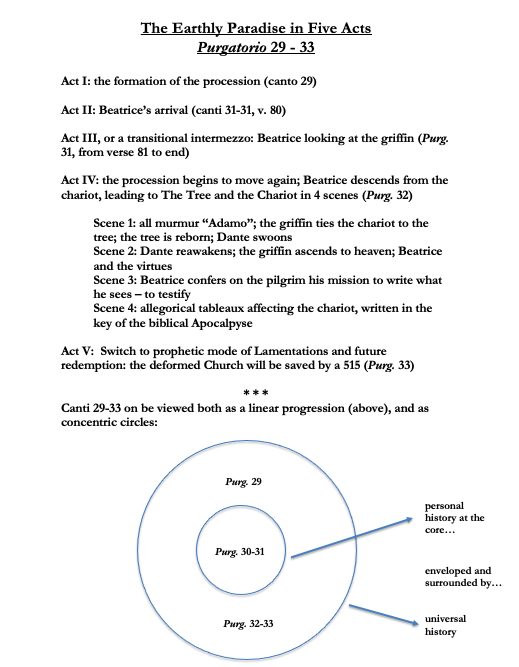
PPS: Another layer I've been exploring has been Dante's The Divine Comedy. I coincidentally found this radial diagram that illustrates the transition from the end of Purgatorio to the beginning of Paradiso. Uncannily, there's some rich thematic parallels between my diagram above, the one below, and BOC's discography. "Personal history enveloped and surrounded by universal history"--at birth, you're closer to the time before you existed (universal history // Music Has The Right To Children,) then you become more and more your own person (centered in The Campfire Headphase // personal history) then, as you get older, you understand your place in the universe more and more (back to universal history // Inferno). There's probably some more interesting stuff to unpack with this connection, but I'd rather not go down that road now. I'll just leave you with the source and the image:
The first thing was the conversation on pages 31 and 32 of the 01. / 02. Introit / Prophecy At 1420 MHz thread. A lot of this post is pulled from what I posted there to give this thread closure. In short, there's a confluence between a few things: the recent official Boards of Canada videos visually referencing fan videos and the promotional material for Inferno embracing the fan mythos that the band previously made efforts to distance themselves from (ie, "After 13 years of silence from the compound..."). This integration of past fan expressions of the reception of Boards of Canada's cultural image back into the work of the band itself amounts to a key feedback loop for Inferno.
The second thing came from Merlin Coverley's 2020 book "Hauntology: Ghosts of Futures Past." All of my musings on this forum made me decide I should finally read something about the subject (I never had previously) and, sure enough, right from the intro it lined up with some of the thoughts I've written here and elsewhere on the forum. At the end on page 20 it reads: "...it appears that the hauntology's changing fortunes may be symptomatic of its subject, as if this concept has come finally to mirror the very condition it seeks to describe. Could it be that we are now haunted by hauntology itself?" I do believe criticism of genAI is a layer in all this, too. It seems to me that its algorithmic exploitation is a sort of logical conclusion and breakdown point of the mirror being pointed at the mirror: it's a sort of artifact that builds artifacts from artifacts almost autonomously, and its feedback manifests as AI slop.
The book also introduced me to the term "dyschronia," referring to the temporally disjunctive nature of our non-linear perception of time which is made more conspicuous by the proliferation of recorded materials in the 21st century. I feel my diagram above was essentially reaching toward this. And, while hauntology deals with how the records and hopes of the past disrupt the linearity of time, Julian Barbour's "platonia" idea does away with time entirely. Maybe it never existed in the first place!
Again, all of this has to do with the "feedback" idea of plugging the output back into the input and getting something exaggerated out. As I'll reiterate later, the core feedback loop of Inferno seems to be nostalgia for nostalgia. Visually, it's like the overblown photo imagery. Artistically, they're taking the stuff fans filled the BOC informational void with (past fan videos, theories, speculation) and are using that as material for new work. Sonically, it's like the feedbacking delay signal.
And again, thematically, at both a personal and societal level our inner demons come from suppressing things or repeatedly engaging in habits (output being directed inward) rather than healthily expressing, engaging with, and working through this stuff so it doesn't become a potentially dangerous obstacle (output being directed outward).
Considering the imagery of a feedback loop alongside the circular radial motif of their albums and the themes of Giraud's Mirror and its blue rose, it struck me that a record is a circle (Tomorrow's Harvest plays with this best with its concentric pairs of tracks). It's like an eye that shows us something while looking back at us, reflecting ourselves. Not just an LP, but a recording--a VHS tape, a sample, a photograph, a text...
...or a primordial radio signal that Prophecy at 1420MHz references. The record of the hydrogen atom. It doesn't just evoke the beginnings of the universe, but the very stuff of which its made. Inferno involves both suffering and the medium in which we live; all our perception is a form of delusion, a ghost, a record, merely a representation of a reality beyond our reckoning, yet it's the only way we have to work with the world. We can't escape it.
The voices in the record are ghosts of long-gone people, and Prophecy at 1420MHz is at the beginning of their universe (the album). It's as though they live out their lives in there thinking it's the real world, but then the needle comes up. Maybe our lives aren't so different! The record is a window that gives us a peek into another world and the people inside it, charged with the ghostly aspect of a recording that uncannily represents, but ultimately is not, reality. It's also a mirror that reflects back something of ourselves--what we take as "reality" is really just electrical representations in our brain, prone to bias and the limits of human sensory perception and memory. Ultimately, all our musings about "what the music means" tell us more about ourselves, perhaps, than whatever the band's intentions are. Boards of Canada's music is an invitation to reflect, and reflection can lead to insight but also to madness!
In Giraud's Mirror, the pairing of the high fidelity jostling sound in the recording and the media crackles of the hexiflexidisc feel like an expression of this. If the crackles are the media "knocking at the door," the jostling sound is the world inside the record knocking back. This thin disc is the place where the veil between realities is the thinnest.
The 7 tessellated hexagons of the promo VHS tape and the hexiflexidisc encapsulate all of this in my view: the radial pattern of people sitting around a campfire, an atomic blast, the nine rings of Inferno, a loop, radio waves, hydrogen atoms, an eye, a window or mirror that offers a view into reality, the record's grooves. All the universe is a record, and we, too, are trapped inside. Along this line of thinking, perhaps all the apparent referential material in Boards of Canada ultimately leads in a circle back to itself: it can hypnotize those who dig into it but ultimately doesn't lead anywhere more definitive than the record itself. This is the core feedback loop of Inferno: nostalgia for nostalgia, hauntology of hauntology.
The hauntology tautology! We're records listening to a record that's a record of a record. Inferno is a powerful realization of what Merlin Coverley said: hauntology "has come finally to mirror the very condition it seeks to describe. Could it be that we are now haunted by hauntology itself?"
In this way, asking "what does Inferno mean?" is as meaningful as asking "what is the meaning of life?" or "why is the sky blue?" It just is. The question is more important than the answer; only you can explore it for yourself. A question is open to possibility and invites reflection and engagement, whereas an answer threatens mystery and personal agency, attempts to stultify the dynamic reality of life, and can lead to dogma.
This isn't nihilistic. It's an affirmation that the meaning of art and life is largely something personal that happens between the subject and the object, and that experience in the act of listening can be neither done for you nor ultimately reduced down to words. In an information vacuum (like the question of what happens after death or the mystery of BOC), people will attempt to seduce you with answers in order to have power and control over you. But becoming a self-actualized person involves growing to a place where you can put your locus of control and trust within yourself.
In short: go enjoy a record, make something meaningful to you, and don't forget to live your own life!
PS: if you're interested in Julian Barbour's conception of time as referenced by Inferno, and also in Buddhism, I recommend Dainin Katagiri's book "Each Moment Is the Universe: Zen And The Way of Being Time." It's a challenging read, but I think it's valuable not only for Buddhists but also for folks looking for a book that complicates Coverley's assertion that hauntology is a "peculiarly English phenomena." People across cultures have been aware of the limitations of ordinary human perception for millennia, and hauntology is just a modern colonialist/late-capitalist manifestation of that.
PPS: Another layer I've been exploring has been Dante's The Divine Comedy. I coincidentally found this radial diagram that illustrates the transition from the end of Purgatorio to the beginning of Paradiso. Uncannily, there's some rich thematic parallels between my diagram above, the one below, and BOC's discography. "Personal history enveloped and surrounded by universal history"--at birth, you're closer to the time before you existed (universal history // Music Has The Right To Children,) then you become more and more your own person (centered in The Campfire Headphase // personal history) then, as you get older, you understand your place in the universe more and more (back to universal history // Inferno). There's probably some more interesting stuff to unpack with this connection, but I'd rather not go down that road now. I'll just leave you with the source and the image:
Verde Hexagon Hashbrown
-
Waterbagel

- Dayvan Cowboy
- Posts: 1953
- Joined: Sun Aug 09, 2009 12:50 am
- Location: gulf coast US
Re: Giraud's Mirror, BOC's Discography, and Other Thoughts
hah, you know - I never thought it about that way! insightful!Redd Panderson wrote:It started with a VHS tape. The part of that cryptic video that interested me the most was the opening disclaimer prohibiting the diffusion of its contents. There's an irony in how this was part of a campaign intended to get the word out, yet it mirrors the story of betrayal in BOC's Old Tunes era tapes. They only shared those 4 tapes with a few trusted people, but they were leaked anyway. Fast-forward to 2026. Fans receive a VHS tape that expressly asks them not to distribute its contents--and what happens? It is digitized and diffused online, picked apart frame by frame, and is now free for all to view. Tape 5 indeed!
delightful post. thanks for the food for thought!

Re: Giraud's Mirror, BOC's Discography, and Other Thoughts
"When I was a kid, about five or six years old, a relative of mine had one of those tacky ceramic owls on their mantelpiece, and it had multifaceted diamante eyes. I as totally obsessed with those sparkly glass eyes, for ages. I felt like looking into them was like looking sideways though everything, right through time. That's what we're trying to do with our music." -Mike
Interestingly Louis Giraud apparently sculpted a lot of animals, some with stones for eyes. I could find a panther with turquoise eyes. Couldn't find an owl though.
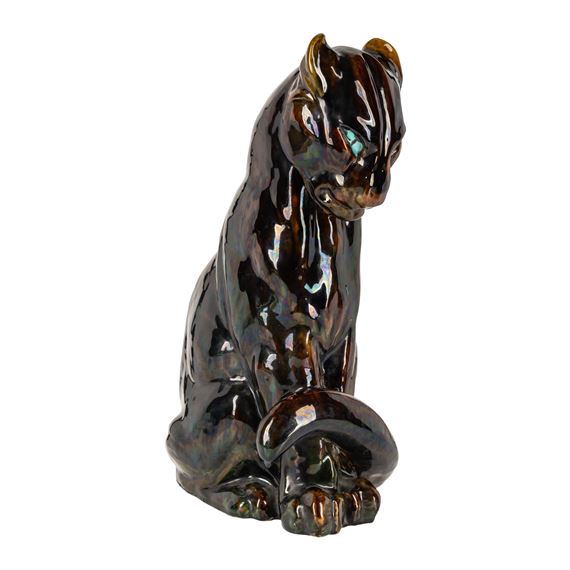
These -are- tacky, so fits Mike's description in that sense.

Throw away your smartphone.
-
Redd Panderson
- Eagle Minded
- Posts: 295
- Joined: Fri Apr 10, 2026 12:36 pm
Re: Giraud's Mirror, BOC's Discography, and Other Thoughts
Somewhere in my rambling posts here was something more coherent. And my brain couldn't leave it alone until I cleaned it up...
This is a much cleaner version of my first three big posts in this thread as one piece that gets my ideas across better, I think (minus Dante...that's a trailhead for another day).
------
Inferno.
Where to begin?
An old copy of In A Beautiful Place Out In The Country hangs on my wall. The morning after my first listen to the new album, I found myself enchanted by the words "boards of canada" as they appear on that now 26-year-old EP. Those familiar words were radiating a new energy to me. The roundness of the letters is now intermixed with memories of the fever dream that is Inferno. It's as though shadows always stretched dancing behind them, but have only now come into view. Like everything they've done was all pointing somewhere off the map, and Inferno was that somewhere.
I also felt a sense of peace. Like if they ended it here, I'd be perfectly content. In the 13 years between Tomorrow's Harvest and Inferno, I'd almost accepted that a new release might not come. Then it did.

It started with a VHS tape. It’s ironic how that cryptic video starts with a disclaimer prohibiting the diffusion of its contents; that’s what opened the campaign to announce their return. And yet, it mirrors the story of betrayal in their Old Tunes era tapes. They only shared those 4 tapes with a few trusted people, but they were leaked anyway. Fast-forward to 2026. Fans receive a VHS tape that expressly asks them not to distribute its contents, and what happens? It is digitized and diffused online, picked apart frame by frame, and is now free for all to view. Tape 05, indeed!
The Inferno VHS demonstrated in real time how art is consumed, distributed at scale, and digested not only by people on the internet, but also by consumer technology itself in the exploitative shadow of generative AI. This is a gastronomic (infernal) process. Inferno is both another log on the fire and a mirror reflecting back an image of what could be considered the all-consuming hellfire of the internet. That which is released is truly surrendered, irrevocably rendered down to “content” to be consumed by the frenzied masses.
After the VHS tape, the stakes were high. 13 years is a long time to go without releasing a scrap of new music, so when Tape 05 dropped, the Brothers Boards weren’t messing around. Its beauty was received very positively by fans. Notably, the reception goes both ways: the Tape 05 video visually references a New Seeds fan video from 11 years prior, amounting to an integration of the fan reception of Boards of Canada back into the official work of the band itself. The promo copy for Inferno would follow the same pattern. It opened with a phrase that embraces the cult mythos the brothers previously made efforts to distance themselves from: "After 13 years of silence from the compound..." These repeating references to fan reception--the leaks, videos, and myth--amount to a circular core dynamic for Inferno: nostalgia for nostalgia.
Tape 05's use of harp is evocative. In the context of faded media music from the past, the crisp acoustic harp is real; it’s the present, ringing out lucidly while enrobed in the fingerprints of time. This is full-circle Boards of Canada. It weaves together eerily familiar threads in a way that evokes absolution–release as a new release, a return, and possibly the completion of Boards of Canada. If Inferno is their final album, then in some sense the band is dead and their body of work enters an afterlife: so you hear angelic harp. The voices fading in at the end of Tape 05, a community of listeners that live on after the music is done: followers. In this light, it fits that the harp plays perhaps the most quintessentially "BOC" melody ever written. It captures that moment when you’re one with your instrument and a melody just flows out of your fingers as though it was channeled through you by the universe, and you’re just a medium. Like this is what Mike and Marcus were put here to do. Not just the past inside the present, but the whole of time in this one moment.
But is Inferno really the end? Will there be another album? Or at least another EP? Dare I say, the fabled BOCset?
Before I weigh in on those questions, let’s take a look at another mystery. One that sits just apart from Inferno and falls enticingly from its pages–flimsy, diaphanous, hexagonal, unassuming, yet contains multitudes:
Giraud's Mirror.
What does the P stand for? What is the significance of 177? Why the 1983 recording date? The McDonald’s sample enjoining us to gift one’s brother with a smile? The blue rose? I won’t dive into all the questions it raises, but I’d like to bring a few trailheads into focus.
Let’s start with the artifact itself. Not the hexiflexidisc, but the eponymous mirror. Twoism user Joshu_atx discovered that this unique mirror was created by author and artist Marcel Giraud who, among other things, wrote about the heinous acts of ethnic cleansing and Christian indoctrination committed by colonialists against the indigenous Métis of Canada. To quote Joshu_atx: "[The mirror has] 6 sides (hexagon, akin to the flexidisc) and 5 loops (5 BOC albums) with a beginning and ending place for the candles but connected overall. This bonus disc is like a bookmark/reset and unifies the whole discography together. It’s ‘everything’ self-contained in one journey. The candles illuminate the mirror. The mirror is what the listener gets from their music reflected back on them." The color of the frame? Turquoise.
Could Giraud’s Mirror be the turquoise hexagon sun? It does appear to reflect the arc of Boards of Canada’s albums. Based on one of their first interviews from 1997, this isn't the only time they were working with a grand project involving a framework of 5 entries:
Mike Sandison: "We have a small company called Music70 and it also produces Super 8 and video films, many of which are quite experimental. I myself am also doing some of these film works and we will soon be shooting our first Super 8 film in feature film length, complete with our own music."
“What is the theme of this film?”
MS: "It will probably be a road movie, but also in a rather broad concept. It is supposed to be a road movie in five parts and that is all we know at the moment."
Their talk of mirrors across multiple interviews further suggests this could be something they've had in mind since their early days:
"Fish and Humans help to form the hexagonal mirror image of the world, as does the presence of birds and all wildlife." -Mike
"Like the intro on 'Julie and Candy' for example, we just played the melody on a couple of whistles and then we bounced it back and forward between the internal mics of two tape-decks until the sound started disappearing into hell. Like when you look at an image reflected within two mirrors forever, in the distance it gets darker and greener and murkier." -Mike
"We create music that seems to have its own universe and time. That place is another reality. It always exists just around the corner, or beyond the mirror."
"[It's] probably 'a soundtrack to a place like the other side of the mirror'. Listening to it, you can dive into an alternate version of the world you know, where history branches off and everything heads in a strange direction." -Mike
"When I was a kid, about five or six years old, a relative of mine had one of those tacky ceramic owls on their mantelpiece, and it had multifaceted diamante eyes. I was totally obsessed with those sparkly glass eyes, for ages. I felt like looking into them was like looking sideways through everything, right through time. That's what we're trying to do with our music." -Mike
As fans of David Lynch’s Twin Peaks may recall, the owls are not what they seem; those diamante eyes bring us to the blue rose. The link between Turquoise Hexagon Sun, Giraud's Mirror, and the blue rose encompasses a lot of the themes Boards of Canada works with.
To unpack this link, it helps to know a bit about Twin Peaks and David Lynch’s artistic vision. In short, "blue rose" designates phenomena that are perpendicular to the veil of reality as we usually perceive it, that transcend space and time in some way, that are, in a word, supernatural. To encounter a "blue rose" is to be near the edge of, as Mike Sandison put it, “looking sideways through everything, right through time." In Twin Peaks, the owls are a blue rose.
David Lynch and Boards of Canada explore overlapping territory in power as both electricity and influence. Like the blue rose, electronic or electronically-mediated records (including audio samples, photographs, websites, books) suggest a means of transcending time by recording a fragment of the past to be held on to--and exert influence--in the present. A major aspect of virtually all of David Lynch’s works is that perception and memory are also electric facsimiles of reality. We live in, essentially, a dream: the illusory world of sensory perception.
Related to this is the negative edge of nostalgia–not necessarily trauma, but the broader momentum of habit that we are often blind to while ending up in the same difficult situations time and again. Behavioral loops that get stuck on repeat in our psyches even as we age and conditions change, fragments of the past that continue to show up in the present, manifesting in different guises that we mistakenly perceive as coming from outside of ourselves. In this way, our past, present, and future are contained in this one moment, with parts of ourselves frozen in the past, making it possible to predict where things are likely to go in the future.
That negative edge of nostalgia is a feedback loop. At both the personal and societal level, our inner demons come from suppression or repeatedly acting out of habit (output being directed back into the self or a system) rather than healthily expressing, engaging with, and processing things before they become harmful (output being directed outward). The closed feedback loop produces monstrous things with exaggerated features in our lives, dreams, and societies, holding power over us until we can cultivate enough equanimity to face them head-on. The exaggerated, even cartoonish, character of our unchecked demons is evoked by the vaguely camp horror faded photograph that is Inferno’s album cover.

There are also power dynamics in the relationship between records and folks who consume them. The internet as it exists in 2026–threatening influence of social media, unchecked surveillance capitalism, the feedback of AI slop, and all–is an example of this. It swells by exploiting and amplifying our human faults to a point of self-destructive feedback. Simultaneously, it offers a hypnotizing facsimile of experience in the form of an endless kaleidoscope of recorded past events while the powers that be exploit and destroy more and more of the world and the human spirit. If information is a religion, perhaps the current structure of the internet resembles a cult.
Inferno isn't strictly a dark album. It's an invitation to shadow work, the difficult healing process of turning to face our demons. To thaw the frozen parts inside. To break the feedback loop and befriend those exiled facets of our psyche so we can rescue ourselves from the havoc they wreak when left unchecked. The prayer in Age of Capricorn resonates like a centering in this practice of reintegrating all of ourselves--the good, bad, and ugly--into the light of awareness and compassion.
Returning to the discography at hand, perhaps Giraud's Mirror integrates even more than their 5 public albums. Its supposed 1983 recording date is another piece of the puzzle, and this is where things start to appear grander. Before taking on the name Boards of Canada, it's known that the brothers were already dabbling with recording music in the early 80s. If Giraud's Mirror contains material recorded in 1983, and Inferno finished production in 2025, that would, technically speaking, make it an album 42 years in the making. What is Inferno about?
In the words of Douglas Adams, "life, the universe, and everything!"
So let's integrate everything. Let's go all the way back to the beginning! If the structure of their public discography is based on Giraud's Mirror, maybe their 5 unreleased pre-Twoism albums were like an early iteration or blueprint of this idea; a reflection, but one that "exists just around the corner, or beyond the mirror."
Two mirrors:
Giraud's Mirror 1:
Catalog 3
Acid Memories
Closes Vol. 1
Play By Numbers
Hooper Bay
Middle EPs:
Twoism
Hi Scores
Giraud's Mirror 2:
Music Has The Right To Children
Geogaddi
The Campfire Headphase
Tomorrow's Harvest
Inferno
Twoism and Hi Scores fit between the two mirrors; both suggest a doubling, splitting, or dualism. In Twoism's case, various spiritual traditions consider "sin" or "evil" to involve forgetting that we're all one: two-ism. As for Hi Scores, it's been speculated that the initials "HI" stand for Hell Interface, Boards of Canada's mysterious and more sinister-sounding pseudonym.
Consider again the spell that emerges from between the mirrors: "...we just played the melody on a couple of whistles and then we bounced it back and forward between the internal mics of two tape-decks until the sound started disappearing into hell. Like when you look at an image reflected within two mirrors forever, in the distance it gets darker and greener and murkier."
Inferno's opener, Introit, may offer support for this grand structure. Its looping melody isn't just 5 beats per measure; it's palindromic, reflected down the middle. Maybe their 5 unreleased pre-Twoism albums and their 5 publicly-released albums circle around Twoism and Hi Scores in the same way that the tracks on Tomorrow's Harvest circle around Collapse, with 5 pairs of somehow related albums mirrored across over 40 years of work.
Focusing on just the 5 mainline albums, there's a beauty to The Campfire Headphase sitting in the middle. It was intended to evoke the sanctuary of a campfire. If you compare that symmetry to the symmetry of the tracks on Tomorrow's Harvest sitting in a circle around Collapse, the same image of a radial pattern around a fire is formed. The yin and yang relationship of one being a welcoming bonfire and the other, presumably, an atomic blast is consistent with Boards of Canada’s themes of precarious spiritual bliss and devotion teetering on the edge of wrath, corruption, and downfall. All 5 mainline albums seem to involve this radial pattern in various ways: Music Has The Right To Children's TV orange broadcasts, Geogaddi's burning Waco compound, the campfire, the atomic blast, and Inferno's 9 rings of hell. Each album is made in the image of the whole.
If a radial pattern is central to Boards of Canada's discography, then what could it mean?
Recall the closed feedback loop, the negative edge of nostalgia, and how the momentum of habit produces predictable outcomes in a way that seems to transcend time. Perhaps this symmetrical 5-album structure is like a model that compares the operation of memory across time to the radial shape of electromagnetic fields. Comparing the human mind with the broadcast and decay of recorded electronic signals would be a very poetic enactment of electronic music as a medium.
Here's one illustration of such a model:
An individual proceeds linearly in time through each tier, passes through the center, then out the other side. Each tier is a concentric loop that transcends time, meaning that there are similar behaviors and outcomes for each circle regardless of which side of the collapse they're on. Predictability is associated with habit, because habit contains the past (its origins) and the future (likely outcomes) in the present. In this way, this model suggests an angle into seeing through platonia, Julian Barbour’s idea that time is an illusion and the past, present, and future are really one eternal now. From this point of view, habit could be seen as the "reverse echo" of a crisis event that already exists in the "future" but that we haven't passed through yet. This also means that, as destructive as they may be, habitual behaviors contain information about the "past" that can be used or abused. Behaviors, memories, ideas, melodies, and records–these things cast spells whose influence reaches across time.
Of course, this model is an abstraction. In reality, there's myriad significant events, behaviors, lives, and histories, positive and negative, all operating dynamically and overlapping like ripples on a lake. It’s still useful. Bringing this model into juxtaposition with the 5 Boards of Canada albums, it fits that they seem to reflect the journey of life:
•Music Has The Right To Children: the times immediately after birth. Childhood, Sesame Street, wonder and whimsy with sinister undercurrents and systems beyond your reckoning that mostly go over your head, but leave a funny feeling.
•Geogaddi: entering and living the teenage years, becoming aware of the light and dark sides of the adult world, beginning to feel angst, and seeking after your own identity.
•The Campfire Headphase: young adulthood. Finding yourself. A new level of freedom after living with parents and before becoming a parent or taking on adult responsibilities yourself. Going on a journey or road trip, culminating in a moment of awakening around a campfire.
•Tomorrow's Harvest: adulthood through midlife crisis, possibly parenthood, reckoning with personal collapse where old ways of living no longer work, cause problems, and gradually need to be let go, while these same sorts of dynamics also unfold at the societal level. More society-level than Inferno, involving the process of solidifying your place in relation to the world. The personal sacrifices that come with age, yet also the beginning of "knowing the score" and the gradual refinement of wisdom.
•Inferno: the times before death. Entering old age, arriving at a personal understanding of your relationship with life and the universe. Joy of mastery. More personal and cosmic than Tomorrow's Harvest. Exorcising old demons at last, facing mortality and accepting loss, reflecting on your legacy and what you will leave the world once your time comes.
Again, it seems very intentional that The Campfire Headphase is the middle album. Before it, there's the beauty and innocence and wonder and fear of childhood. Those older albums have a lower fidelity and, in some ways, a relative simplicity, like an old photograph faded by time. After The Campfire Headphase, there's a more mature, cinematic clarity that explores light and dark and coming to terms with our demons and what's been wrought. The Campfire Headphase is that brief, weightless respite of freedom in young adulthood before responsibilities and the momentum of old habits pull you down.
Dayvan Cowboy is the pivot point. The awakening. In the 90 tracks across their 5 mainline albums, it’s track 45, sharing the middle with A Moment Of Clarity, which leads into the slower, moodier second half of The Campfire Headphase. This same tonal shift exists at the discography level, too, leading to that overall darker and more cinematic style of Tomorrow's Harvest and Inferno. It's hard to imagine this confluence being a coincidence: Dayvan Cowboy is at the center of five albums, it's the fifth track of the center album, and it's exactly 5 minutes long, with a transcendent transition in the middle. Just look at the music video of falling to Earth from the upper atmosphere; it evokes groundedness in gravity's radial pattern of celestial objects in orbit! We're at once woven into and made up of this radial shape, a fractal spiraling through space.
So there's an apparent confluence within Boards of Canada's artistic decisions, from self-reference and creative integration of fan reception to the structure of their discography, all centered in a radial shape. Consciousness seated in a center of gravity. Feedback loops and the illusion of time. The poetic potential of memory and electromagnetic fields. What could it all mean?
Merlin Coverley's 2020 book "Hauntology: Ghosts of Futures Past" seems prophetic: "...it appears that hauntology's changing fortunes may be symptomatic of its subject, as if this concept has come finally to mirror the very condition it seeks to describe. Could it be that we are now haunted by hauntology itself?"
Bringing together the ubiquitous radial shape, Giraud's Mirror, and the blue rose, it struck me that a record, too, is a circle. Not just an LP, but a recording. A VHS tape, a sample, a photograph, a text, a memory, or the primordial radio signal referenced in Prophecy at 1420 MHz: the record of the hydrogen atom. A window through time.
The voices in Inferno are ghosts of long-gone people, and Prophecy at 1420 MHz is at the beginning of their universe (the record). They live out their lives in there thinking it's the real world and trying to make sense of it, but then the needle comes up. Maybe our lives aren't so different! The record is a window that gives us a glimpse of another reality while reflecting back something of ourselves; what we take as "reality" is really just electrical representations in our brain, prone to bias and the limits of human sensory perception and memory. Ultimately, all our musings about "what the music means" tell us more about ourselves, perhaps, than whatever the band's intentions are. Boards of Canada's music is an invitation to reflect, and reflection can lead to insight but also to madness!

The 7 tessellated hexagons of Inferno’s promo VHS tape and the hexiflexidisc encompass all of this in my view: the radial pattern of people sitting around a campfire, the atomic blast, the 9 rings of Inferno, electromagnetic fields, feedback loops, hydrogen atoms, an eye that offers a view into reality, the record's grooves. All the universe is a record, and we, too, are trapped inside. Maybe all the referential material in Boards of Canada leads in a circle back to itself: it can enchant those who look closely but ultimately doesn't lead anywhere more definitive than the act of listening. This is the core feedback loop of Inferno: nostalgia for nostalgia. Hauntology of hauntology.
We're records listening to a record that's a record of a record. The hexiflexidisc crackles on the turntable as we peer inside; the jostling sound in Giraud's Mirror peers back. This thin disc is the place where the veil between realities is the thinnest.
In the end, asking "what does Inferno mean?" seems as useful as asking "why is the sky blue?" or "what is the meaning of life?" It just is. The question is more important than the answer.
“Nothingness. The absolute truth.”
This isn't nihilistic. It's an affirmation that the meaning of art and life is something personal that happens between the subject and the object. The experience of listening can neither be done for you nor truly reduced down to words. In an information vacuum (like the mysteries of BOC or the question of what happens after death), people will attempt to enchant you with answers in order to have power over you. And while some answers sound really beautiful, becoming a self-actualized person involves growing to a place where you can center your locus of power within yourself. A question allows for the agency that an answer threatens.
If all of this says anything, maybe it's this: only now is real. There are no good old days to return to, and trying to recreate the past is ultimately self-destructive. Inferno would inevitably disappoint some listeners, so instead of struggling to make another Music Has The Right To Children, Boards of Canada "branches off and heads in a strange direction." Only we can decide between clutching our dusty old records and keeping our ears shut to the present, or diving in.
So what about all the questions left unanswered? Do all of their releases follow the same grand pattern? Is Giraud's Mirror the turquoise hexagon sun?
I'll leave you with three "very important thoughts."
One: The mirror is the map. Maybe "the greatest gift is the smile you give to your brother" sample in Giraud's Mirror isn't just a sweet recognition of the brothers' musical journey together, but also a victory lap after completing a second conceptual Giraud's Mirror of releases. Two brothers, two mirrors.
Two: Inferno appears to close the loop. Based on all this hypothesizing, my hunch is that we're not going to get another new Boards of Canada album. However, we might get a fifth EP, and some unreleased materials may yet see the light of day. The mythological 5 pre-Twoism albums? Their magic seems to work best from the shadows.
Three: A quote from Marcus Eoin in the 2000 interview "Boards of the Underground," published hot on the heels of In A Beautiful Place Out In The Country: "One time we were out in the woods on a really wet day. My friend bet me I couldn't start a fire using only one match. But I managed to get this meagre little flame going in this damp little patch of ground. Then when we were about a mile down the road, we looked back and it was like, 'whoosh!' - the whole wood was on fire!"
Inferno!
This is a much cleaner version of my first three big posts in this thread as one piece that gets my ideas across better, I think (minus Dante...that's a trailhead for another day).
------
Inferno.
Where to begin?
An old copy of In A Beautiful Place Out In The Country hangs on my wall. The morning after my first listen to the new album, I found myself enchanted by the words "boards of canada" as they appear on that now 26-year-old EP. Those familiar words were radiating a new energy to me. The roundness of the letters is now intermixed with memories of the fever dream that is Inferno. It's as though shadows always stretched dancing behind them, but have only now come into view. Like everything they've done was all pointing somewhere off the map, and Inferno was that somewhere.
I also felt a sense of peace. Like if they ended it here, I'd be perfectly content. In the 13 years between Tomorrow's Harvest and Inferno, I'd almost accepted that a new release might not come. Then it did.
It started with a VHS tape. It’s ironic how that cryptic video starts with a disclaimer prohibiting the diffusion of its contents; that’s what opened the campaign to announce their return. And yet, it mirrors the story of betrayal in their Old Tunes era tapes. They only shared those 4 tapes with a few trusted people, but they were leaked anyway. Fast-forward to 2026. Fans receive a VHS tape that expressly asks them not to distribute its contents, and what happens? It is digitized and diffused online, picked apart frame by frame, and is now free for all to view. Tape 05, indeed!
The Inferno VHS demonstrated in real time how art is consumed, distributed at scale, and digested not only by people on the internet, but also by consumer technology itself in the exploitative shadow of generative AI. This is a gastronomic (infernal) process. Inferno is both another log on the fire and a mirror reflecting back an image of what could be considered the all-consuming hellfire of the internet. That which is released is truly surrendered, irrevocably rendered down to “content” to be consumed by the frenzied masses.
After the VHS tape, the stakes were high. 13 years is a long time to go without releasing a scrap of new music, so when Tape 05 dropped, the Brothers Boards weren’t messing around. Its beauty was received very positively by fans. Notably, the reception goes both ways: the Tape 05 video visually references a New Seeds fan video from 11 years prior, amounting to an integration of the fan reception of Boards of Canada back into the official work of the band itself. The promo copy for Inferno would follow the same pattern. It opened with a phrase that embraces the cult mythos the brothers previously made efforts to distance themselves from: "After 13 years of silence from the compound..." These repeating references to fan reception--the leaks, videos, and myth--amount to a circular core dynamic for Inferno: nostalgia for nostalgia.
Tape 05's use of harp is evocative. In the context of faded media music from the past, the crisp acoustic harp is real; it’s the present, ringing out lucidly while enrobed in the fingerprints of time. This is full-circle Boards of Canada. It weaves together eerily familiar threads in a way that evokes absolution–release as a new release, a return, and possibly the completion of Boards of Canada. If Inferno is their final album, then in some sense the band is dead and their body of work enters an afterlife: so you hear angelic harp. The voices fading in at the end of Tape 05, a community of listeners that live on after the music is done: followers. In this light, it fits that the harp plays perhaps the most quintessentially "BOC" melody ever written. It captures that moment when you’re one with your instrument and a melody just flows out of your fingers as though it was channeled through you by the universe, and you’re just a medium. Like this is what Mike and Marcus were put here to do. Not just the past inside the present, but the whole of time in this one moment.
But is Inferno really the end? Will there be another album? Or at least another EP? Dare I say, the fabled BOCset?
Before I weigh in on those questions, let’s take a look at another mystery. One that sits just apart from Inferno and falls enticingly from its pages–flimsy, diaphanous, hexagonal, unassuming, yet contains multitudes:
Giraud's Mirror.
What does the P stand for? What is the significance of 177? Why the 1983 recording date? The McDonald’s sample enjoining us to gift one’s brother with a smile? The blue rose? I won’t dive into all the questions it raises, but I’d like to bring a few trailheads into focus.
Let’s start with the artifact itself. Not the hexiflexidisc, but the eponymous mirror. Twoism user Joshu_atx discovered that this unique mirror was created by author and artist Marcel Giraud who, among other things, wrote about the heinous acts of ethnic cleansing and Christian indoctrination committed by colonialists against the indigenous Métis of Canada. To quote Joshu_atx: "[The mirror has] 6 sides (hexagon, akin to the flexidisc) and 5 loops (5 BOC albums) with a beginning and ending place for the candles but connected overall. This bonus disc is like a bookmark/reset and unifies the whole discography together. It’s ‘everything’ self-contained in one journey. The candles illuminate the mirror. The mirror is what the listener gets from their music reflected back on them." The color of the frame? Turquoise.
Could Giraud’s Mirror be the turquoise hexagon sun? It does appear to reflect the arc of Boards of Canada’s albums. Based on one of their first interviews from 1997, this isn't the only time they were working with a grand project involving a framework of 5 entries:
Mike Sandison: "We have a small company called Music70 and it also produces Super 8 and video films, many of which are quite experimental. I myself am also doing some of these film works and we will soon be shooting our first Super 8 film in feature film length, complete with our own music."
“What is the theme of this film?”
MS: "It will probably be a road movie, but also in a rather broad concept. It is supposed to be a road movie in five parts and that is all we know at the moment."
Their talk of mirrors across multiple interviews further suggests this could be something they've had in mind since their early days:
"Fish and Humans help to form the hexagonal mirror image of the world, as does the presence of birds and all wildlife." -Mike
"Like the intro on 'Julie and Candy' for example, we just played the melody on a couple of whistles and then we bounced it back and forward between the internal mics of two tape-decks until the sound started disappearing into hell. Like when you look at an image reflected within two mirrors forever, in the distance it gets darker and greener and murkier." -Mike
"We create music that seems to have its own universe and time. That place is another reality. It always exists just around the corner, or beyond the mirror."
"[It's] probably 'a soundtrack to a place like the other side of the mirror'. Listening to it, you can dive into an alternate version of the world you know, where history branches off and everything heads in a strange direction." -Mike
"When I was a kid, about five or six years old, a relative of mine had one of those tacky ceramic owls on their mantelpiece, and it had multifaceted diamante eyes. I was totally obsessed with those sparkly glass eyes, for ages. I felt like looking into them was like looking sideways through everything, right through time. That's what we're trying to do with our music." -Mike
As fans of David Lynch’s Twin Peaks may recall, the owls are not what they seem; those diamante eyes bring us to the blue rose. The link between Turquoise Hexagon Sun, Giraud's Mirror, and the blue rose encompasses a lot of the themes Boards of Canada works with.
To unpack this link, it helps to know a bit about Twin Peaks and David Lynch’s artistic vision. In short, "blue rose" designates phenomena that are perpendicular to the veil of reality as we usually perceive it, that transcend space and time in some way, that are, in a word, supernatural. To encounter a "blue rose" is to be near the edge of, as Mike Sandison put it, “looking sideways through everything, right through time." In Twin Peaks, the owls are a blue rose.
David Lynch and Boards of Canada explore overlapping territory in power as both electricity and influence. Like the blue rose, electronic or electronically-mediated records (including audio samples, photographs, websites, books) suggest a means of transcending time by recording a fragment of the past to be held on to--and exert influence--in the present. A major aspect of virtually all of David Lynch’s works is that perception and memory are also electric facsimiles of reality. We live in, essentially, a dream: the illusory world of sensory perception.
Related to this is the negative edge of nostalgia–not necessarily trauma, but the broader momentum of habit that we are often blind to while ending up in the same difficult situations time and again. Behavioral loops that get stuck on repeat in our psyches even as we age and conditions change, fragments of the past that continue to show up in the present, manifesting in different guises that we mistakenly perceive as coming from outside of ourselves. In this way, our past, present, and future are contained in this one moment, with parts of ourselves frozen in the past, making it possible to predict where things are likely to go in the future.
That negative edge of nostalgia is a feedback loop. At both the personal and societal level, our inner demons come from suppression or repeatedly acting out of habit (output being directed back into the self or a system) rather than healthily expressing, engaging with, and processing things before they become harmful (output being directed outward). The closed feedback loop produces monstrous things with exaggerated features in our lives, dreams, and societies, holding power over us until we can cultivate enough equanimity to face them head-on. The exaggerated, even cartoonish, character of our unchecked demons is evoked by the vaguely camp horror faded photograph that is Inferno’s album cover.
There are also power dynamics in the relationship between records and folks who consume them. The internet as it exists in 2026–threatening influence of social media, unchecked surveillance capitalism, the feedback of AI slop, and all–is an example of this. It swells by exploiting and amplifying our human faults to a point of self-destructive feedback. Simultaneously, it offers a hypnotizing facsimile of experience in the form of an endless kaleidoscope of recorded past events while the powers that be exploit and destroy more and more of the world and the human spirit. If information is a religion, perhaps the current structure of the internet resembles a cult.
Inferno isn't strictly a dark album. It's an invitation to shadow work, the difficult healing process of turning to face our demons. To thaw the frozen parts inside. To break the feedback loop and befriend those exiled facets of our psyche so we can rescue ourselves from the havoc they wreak when left unchecked. The prayer in Age of Capricorn resonates like a centering in this practice of reintegrating all of ourselves--the good, bad, and ugly--into the light of awareness and compassion.
Returning to the discography at hand, perhaps Giraud's Mirror integrates even more than their 5 public albums. Its supposed 1983 recording date is another piece of the puzzle, and this is where things start to appear grander. Before taking on the name Boards of Canada, it's known that the brothers were already dabbling with recording music in the early 80s. If Giraud's Mirror contains material recorded in 1983, and Inferno finished production in 2025, that would, technically speaking, make it an album 42 years in the making. What is Inferno about?
In the words of Douglas Adams, "life, the universe, and everything!"
So let's integrate everything. Let's go all the way back to the beginning! If the structure of their public discography is based on Giraud's Mirror, maybe their 5 unreleased pre-Twoism albums were like an early iteration or blueprint of this idea; a reflection, but one that "exists just around the corner, or beyond the mirror."
Two mirrors:
Giraud's Mirror 1:
Catalog 3
Acid Memories
Closes Vol. 1
Play By Numbers
Hooper Bay
Middle EPs:
Twoism
Hi Scores
Giraud's Mirror 2:
Music Has The Right To Children
Geogaddi
The Campfire Headphase
Tomorrow's Harvest
Inferno
Twoism and Hi Scores fit between the two mirrors; both suggest a doubling, splitting, or dualism. In Twoism's case, various spiritual traditions consider "sin" or "evil" to involve forgetting that we're all one: two-ism. As for Hi Scores, it's been speculated that the initials "HI" stand for Hell Interface, Boards of Canada's mysterious and more sinister-sounding pseudonym.
Consider again the spell that emerges from between the mirrors: "...we just played the melody on a couple of whistles and then we bounced it back and forward between the internal mics of two tape-decks until the sound started disappearing into hell. Like when you look at an image reflected within two mirrors forever, in the distance it gets darker and greener and murkier."
Inferno's opener, Introit, may offer support for this grand structure. Its looping melody isn't just 5 beats per measure; it's palindromic, reflected down the middle. Maybe their 5 unreleased pre-Twoism albums and their 5 publicly-released albums circle around Twoism and Hi Scores in the same way that the tracks on Tomorrow's Harvest circle around Collapse, with 5 pairs of somehow related albums mirrored across over 40 years of work.
Focusing on just the 5 mainline albums, there's a beauty to The Campfire Headphase sitting in the middle. It was intended to evoke the sanctuary of a campfire. If you compare that symmetry to the symmetry of the tracks on Tomorrow's Harvest sitting in a circle around Collapse, the same image of a radial pattern around a fire is formed. The yin and yang relationship of one being a welcoming bonfire and the other, presumably, an atomic blast is consistent with Boards of Canada’s themes of precarious spiritual bliss and devotion teetering on the edge of wrath, corruption, and downfall. All 5 mainline albums seem to involve this radial pattern in various ways: Music Has The Right To Children's TV orange broadcasts, Geogaddi's burning Waco compound, the campfire, the atomic blast, and Inferno's 9 rings of hell. Each album is made in the image of the whole.
If a radial pattern is central to Boards of Canada's discography, then what could it mean?
Recall the closed feedback loop, the negative edge of nostalgia, and how the momentum of habit produces predictable outcomes in a way that seems to transcend time. Perhaps this symmetrical 5-album structure is like a model that compares the operation of memory across time to the radial shape of electromagnetic fields. Comparing the human mind with the broadcast and decay of recorded electronic signals would be a very poetic enactment of electronic music as a medium.
Here's one illustration of such a model:
An individual proceeds linearly in time through each tier, passes through the center, then out the other side. Each tier is a concentric loop that transcends time, meaning that there are similar behaviors and outcomes for each circle regardless of which side of the collapse they're on. Predictability is associated with habit, because habit contains the past (its origins) and the future (likely outcomes) in the present. In this way, this model suggests an angle into seeing through platonia, Julian Barbour’s idea that time is an illusion and the past, present, and future are really one eternal now. From this point of view, habit could be seen as the "reverse echo" of a crisis event that already exists in the "future" but that we haven't passed through yet. This also means that, as destructive as they may be, habitual behaviors contain information about the "past" that can be used or abused. Behaviors, memories, ideas, melodies, and records–these things cast spells whose influence reaches across time.
Of course, this model is an abstraction. In reality, there's myriad significant events, behaviors, lives, and histories, positive and negative, all operating dynamically and overlapping like ripples on a lake. It’s still useful. Bringing this model into juxtaposition with the 5 Boards of Canada albums, it fits that they seem to reflect the journey of life:
•Music Has The Right To Children: the times immediately after birth. Childhood, Sesame Street, wonder and whimsy with sinister undercurrents and systems beyond your reckoning that mostly go over your head, but leave a funny feeling.
•Geogaddi: entering and living the teenage years, becoming aware of the light and dark sides of the adult world, beginning to feel angst, and seeking after your own identity.
•The Campfire Headphase: young adulthood. Finding yourself. A new level of freedom after living with parents and before becoming a parent or taking on adult responsibilities yourself. Going on a journey or road trip, culminating in a moment of awakening around a campfire.
•Tomorrow's Harvest: adulthood through midlife crisis, possibly parenthood, reckoning with personal collapse where old ways of living no longer work, cause problems, and gradually need to be let go, while these same sorts of dynamics also unfold at the societal level. More society-level than Inferno, involving the process of solidifying your place in relation to the world. The personal sacrifices that come with age, yet also the beginning of "knowing the score" and the gradual refinement of wisdom.
•Inferno: the times before death. Entering old age, arriving at a personal understanding of your relationship with life and the universe. Joy of mastery. More personal and cosmic than Tomorrow's Harvest. Exorcising old demons at last, facing mortality and accepting loss, reflecting on your legacy and what you will leave the world once your time comes.
Again, it seems very intentional that The Campfire Headphase is the middle album. Before it, there's the beauty and innocence and wonder and fear of childhood. Those older albums have a lower fidelity and, in some ways, a relative simplicity, like an old photograph faded by time. After The Campfire Headphase, there's a more mature, cinematic clarity that explores light and dark and coming to terms with our demons and what's been wrought. The Campfire Headphase is that brief, weightless respite of freedom in young adulthood before responsibilities and the momentum of old habits pull you down.
Dayvan Cowboy is the pivot point. The awakening. In the 90 tracks across their 5 mainline albums, it’s track 45, sharing the middle with A Moment Of Clarity, which leads into the slower, moodier second half of The Campfire Headphase. This same tonal shift exists at the discography level, too, leading to that overall darker and more cinematic style of Tomorrow's Harvest and Inferno. It's hard to imagine this confluence being a coincidence: Dayvan Cowboy is at the center of five albums, it's the fifth track of the center album, and it's exactly 5 minutes long, with a transcendent transition in the middle. Just look at the music video of falling to Earth from the upper atmosphere; it evokes groundedness in gravity's radial pattern of celestial objects in orbit! We're at once woven into and made up of this radial shape, a fractal spiraling through space.
So there's an apparent confluence within Boards of Canada's artistic decisions, from self-reference and creative integration of fan reception to the structure of their discography, all centered in a radial shape. Consciousness seated in a center of gravity. Feedback loops and the illusion of time. The poetic potential of memory and electromagnetic fields. What could it all mean?
Merlin Coverley's 2020 book "Hauntology: Ghosts of Futures Past" seems prophetic: "...it appears that hauntology's changing fortunes may be symptomatic of its subject, as if this concept has come finally to mirror the very condition it seeks to describe. Could it be that we are now haunted by hauntology itself?"
Bringing together the ubiquitous radial shape, Giraud's Mirror, and the blue rose, it struck me that a record, too, is a circle. Not just an LP, but a recording. A VHS tape, a sample, a photograph, a text, a memory, or the primordial radio signal referenced in Prophecy at 1420 MHz: the record of the hydrogen atom. A window through time.
The voices in Inferno are ghosts of long-gone people, and Prophecy at 1420 MHz is at the beginning of their universe (the record). They live out their lives in there thinking it's the real world and trying to make sense of it, but then the needle comes up. Maybe our lives aren't so different! The record is a window that gives us a glimpse of another reality while reflecting back something of ourselves; what we take as "reality" is really just electrical representations in our brain, prone to bias and the limits of human sensory perception and memory. Ultimately, all our musings about "what the music means" tell us more about ourselves, perhaps, than whatever the band's intentions are. Boards of Canada's music is an invitation to reflect, and reflection can lead to insight but also to madness!
The 7 tessellated hexagons of Inferno’s promo VHS tape and the hexiflexidisc encompass all of this in my view: the radial pattern of people sitting around a campfire, the atomic blast, the 9 rings of Inferno, electromagnetic fields, feedback loops, hydrogen atoms, an eye that offers a view into reality, the record's grooves. All the universe is a record, and we, too, are trapped inside. Maybe all the referential material in Boards of Canada leads in a circle back to itself: it can enchant those who look closely but ultimately doesn't lead anywhere more definitive than the act of listening. This is the core feedback loop of Inferno: nostalgia for nostalgia. Hauntology of hauntology.
We're records listening to a record that's a record of a record. The hexiflexidisc crackles on the turntable as we peer inside; the jostling sound in Giraud's Mirror peers back. This thin disc is the place where the veil between realities is the thinnest.
In the end, asking "what does Inferno mean?" seems as useful as asking "why is the sky blue?" or "what is the meaning of life?" It just is. The question is more important than the answer.
“Nothingness. The absolute truth.”
This isn't nihilistic. It's an affirmation that the meaning of art and life is something personal that happens between the subject and the object. The experience of listening can neither be done for you nor truly reduced down to words. In an information vacuum (like the mysteries of BOC or the question of what happens after death), people will attempt to enchant you with answers in order to have power over you. And while some answers sound really beautiful, becoming a self-actualized person involves growing to a place where you can center your locus of power within yourself. A question allows for the agency that an answer threatens.
If all of this says anything, maybe it's this: only now is real. There are no good old days to return to, and trying to recreate the past is ultimately self-destructive. Inferno would inevitably disappoint some listeners, so instead of struggling to make another Music Has The Right To Children, Boards of Canada "branches off and heads in a strange direction." Only we can decide between clutching our dusty old records and keeping our ears shut to the present, or diving in.
So what about all the questions left unanswered? Do all of their releases follow the same grand pattern? Is Giraud's Mirror the turquoise hexagon sun?
I'll leave you with three "very important thoughts."
One: The mirror is the map. Maybe "the greatest gift is the smile you give to your brother" sample in Giraud's Mirror isn't just a sweet recognition of the brothers' musical journey together, but also a victory lap after completing a second conceptual Giraud's Mirror of releases. Two brothers, two mirrors.
Two: Inferno appears to close the loop. Based on all this hypothesizing, my hunch is that we're not going to get another new Boards of Canada album. However, we might get a fifth EP, and some unreleased materials may yet see the light of day. The mythological 5 pre-Twoism albums? Their magic seems to work best from the shadows.
Three: A quote from Marcus Eoin in the 2000 interview "Boards of the Underground," published hot on the heels of In A Beautiful Place Out In The Country: "One time we were out in the woods on a really wet day. My friend bet me I couldn't start a fire using only one match. But I managed to get this meagre little flame going in this damp little patch of ground. Then when we were about a mile down the road, we looked back and it was like, 'whoosh!' - the whole wood was on fire!"
Inferno!
Verde Hexagon Hashbrown